
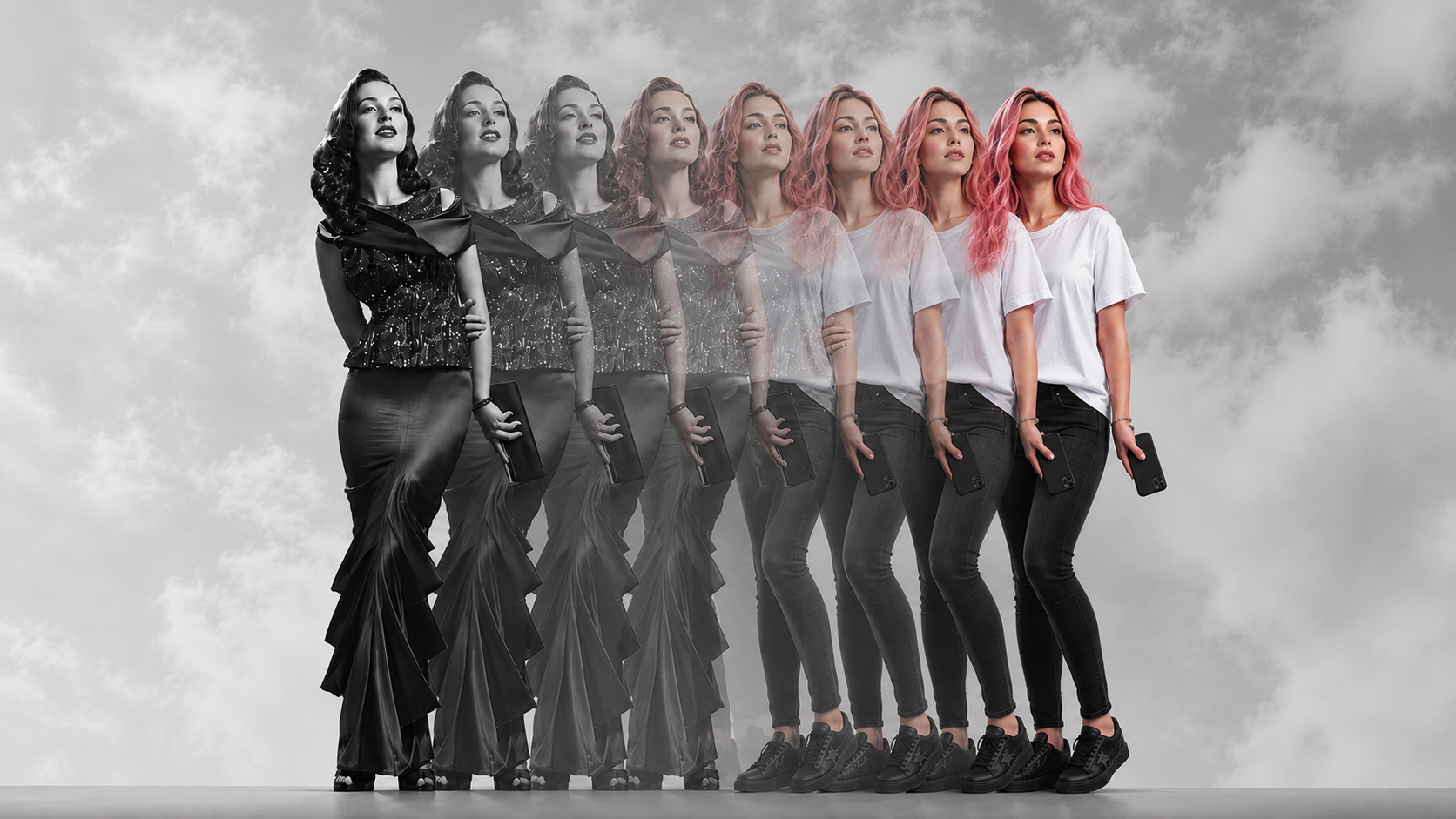
Everyone in entertainment has spent the past year (at least) focused on how to stop or slow down AI: scaring each other about the end of the industry, fear-mongering a world where beloved stories are forgotten and the heroes of our time are replaced by the likes of the Cheating Fruits and Tung Tung Tung Sahur.
(Disclaimer: I'm only going to be talking about entertainment here today, not what AI means for the economy and society at large. One thing at a time.)
That debate is moot. AI is here and it's only going to keep on coming. We are wasting our breath litigating whether to allow it, that ship has sailed. The better (and only relevant) question left is whether it can be this industry's second wind or its last breath. I'm strongly of the mind that AI will actually prove to be a good thing.
The "obvious" threat from AI is that it commodifies Hollywood's product: the content. But content was never Hollywood's product. From street performers to early YouTubers to Twitch live-streamers, there has always been content given away free to anyone willing to watch. Hollywood's product is its discernment, the filter that decides, out of everything that could exist, what deserves a megaphone, a platform to be shown to the whole world. Or, as the LinkedIn bros would put it: "their moat is taste."
AI is commoditizing the part of the business that was never really the moat, and making the real one increasingly more necessary and more valuable.
The death of Sora
Sora died on a Tuesday in late March. OpenAI shut down its flagship video app with so little warning that Disney, its billion-dollar partner, reportedly found out less than an hour before the public. The deal that would have put hundreds of Disney characters into an infinite prompt machine dissolved the same afternoon, and the post-mortems wrote themselves: "more proof that Hollywood is dying!"
But on closer inspection, the shutoff proves something closer to the opposite: infinite content is not a revolutionary new business model. The most valuable AI company in the world, holding rights to the most valuable character library in the world, could not find enough people who wanted infinite content. It's hard to read that as an execution problem.
None of this means the technology is broken. Watching Google's Veo and ByteDance's Seedance ship better models month after month makes it clear the underlying technology is real and valuable. But valuable to who? Well… let's look at the deals that are happening.
Let's follow the money
This spring, while everyone was writing eulogies, the studios went shopping. Google DeepMind put $75 million into A24. Amazon MGM built an AI production platform and a creators' fund. Netflix bought an AI filmmaking startup. Lionsgate hired the industry's first chief AI officer.
Not one of these deals moves toward infinite content. Look at the shape of them: the A24 partnership grants no access to the studio's library, and the first tool being built is a storyboard generator. Amazon's platform tracks the provenance of every asset, and even its AI-made shows still run through its own greenlight. Some of that caution is legal necessity, sure (labor agreements and training-data litigation limit what studios can touch), but the pattern holds across every deal: AI is being bought as leverage for existing pipelines, and the judgment is staying in-house.
That tells you what the studios believe their real asset is, whether or not they'd position it this way. And it tells you what the labs learned from Sora: the value of this technology is not in letting anyone make anything. It's in helping the people who already make great things make them faster, cheaper, and better.
A historical case against The New Thing & why More is Less
Some version of the "this is the end of Hollywood" scare has happened at least four times in my lifetime. For production it was the digital camcorder (I was a baby) and later the iPhone and iMovie (early adopter here! I was in third grade). For distribution it was YouTube, then Kindle self-publishing. Each time, the same sequence:
- Gatekeepers pronounced dead
- Content floods in
- The flood actually makes the gatekeepers' picks even more valuable
As a parallel, music is the cleanest data we have to illustrate this point. The catalog on streaming services grew 60% in the past three years, from 158 million tracks to 253 million, with 106,000 new ones arriving every day on average. While that happened, the share of tracks anyone meaningfully listens to shrank: 88 percent of everything on streaming got fewer than a thousand plays last year, and about 0.2% of the catalog accounted for roughly half of all streaming worldwide. In simplest terms: the supply of content exploded and yet attention concentrated towards the top.
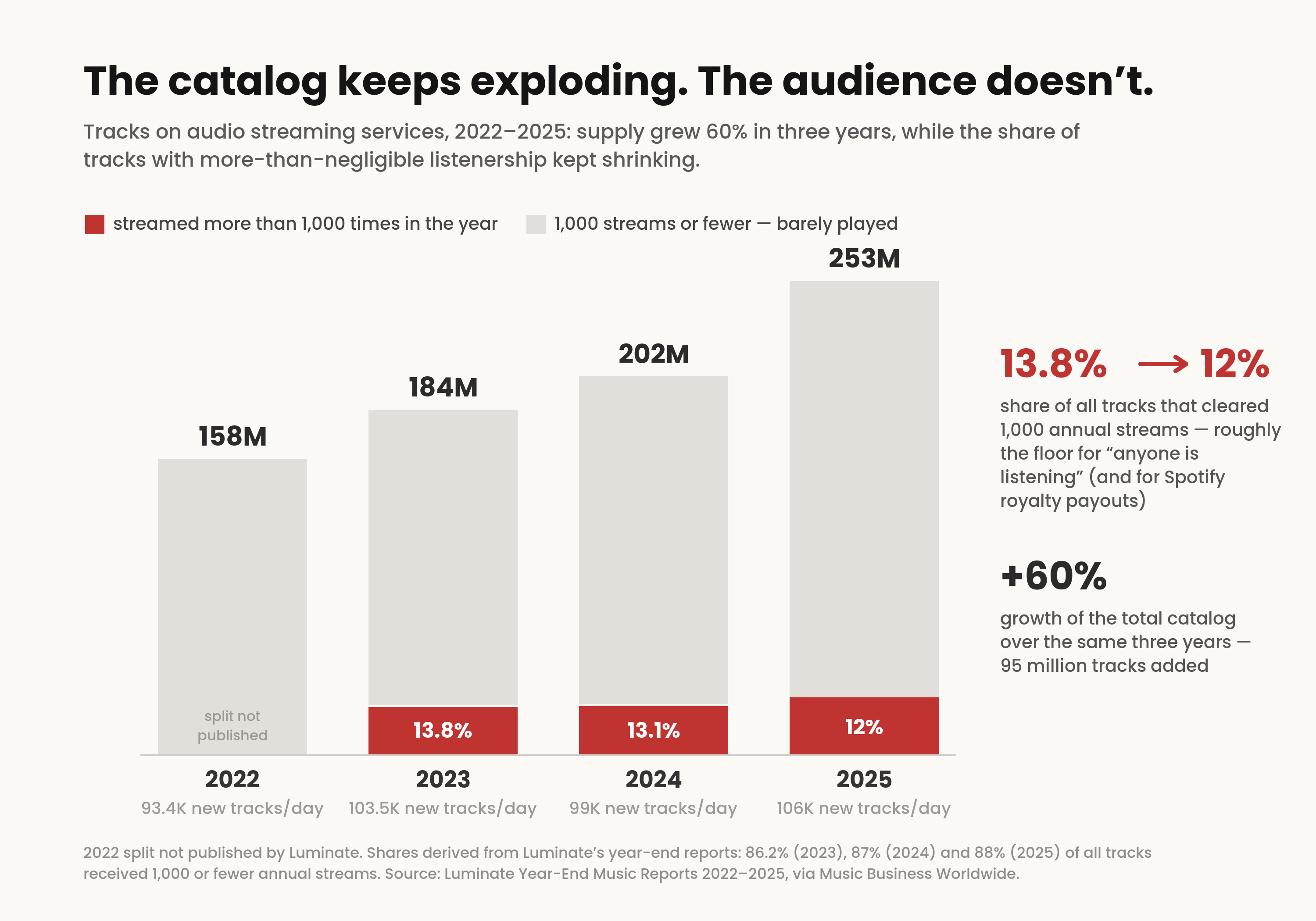
This is a studied phenomenon, and not a new one (would love to take credit but I'm about two decades too late); HBS professor Anita Elberse spent years studying it, and definitively documented it in Blockbusters: the more choice explodes, the harder audiences coordinate around the few things everyone else is watching. To use her words, "markets become ever more concentrated, leading to 'winner-take-all' tendencies."
And if you think the filter isn't real — that enough money pointed at anything will make people watch it — you need look no further back than May of this year.
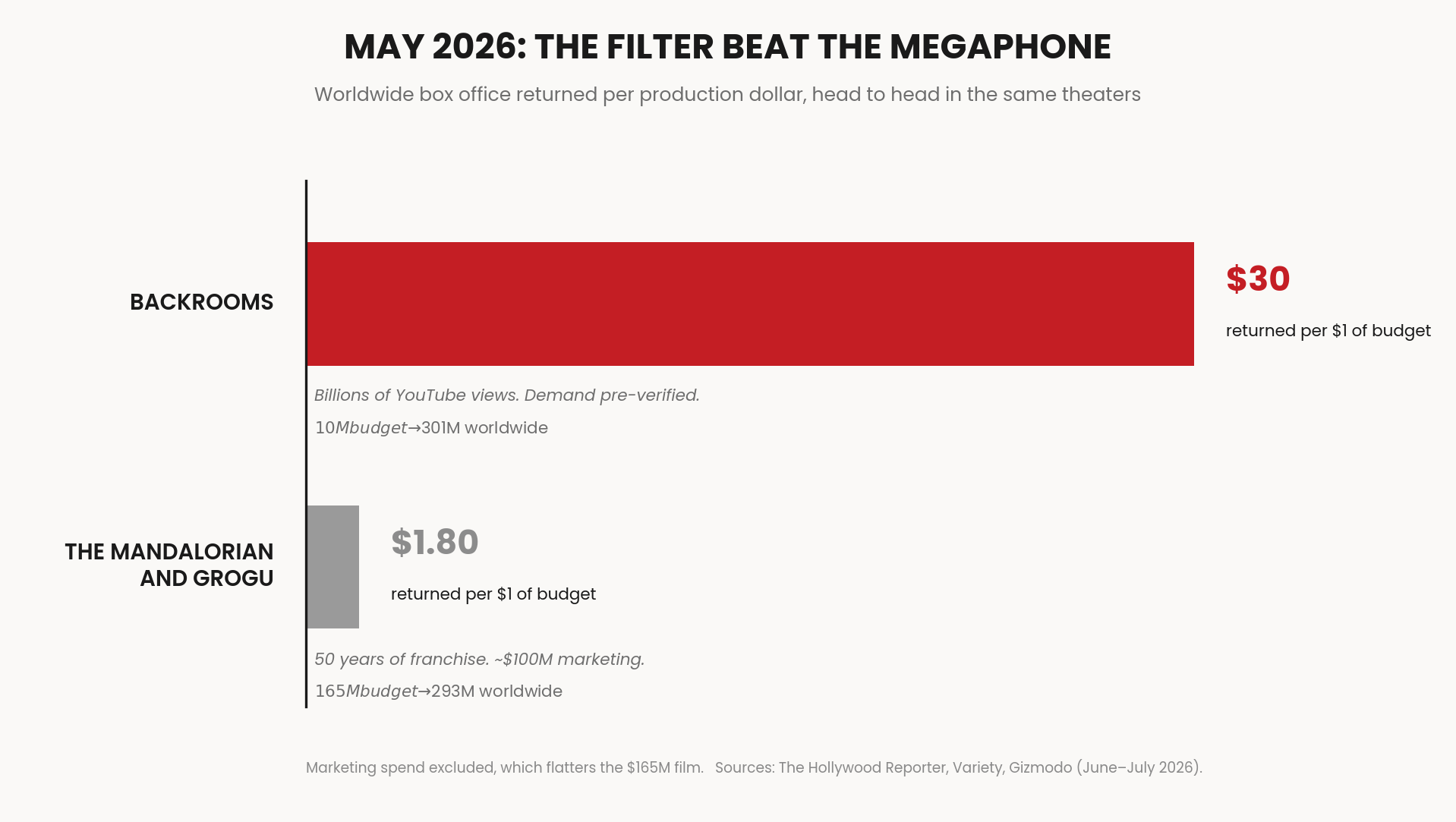
Disney spent a reported $100 million marketing the theatrical return of Star Wars (absolutely mouth-watering IP), on top of a $165 million budget, and where did it get them? The Mandalorian and Grogu opened to… $82 million(??!!). Even if the film had been AI-generated for a tenth of its original cost, the marketing alone cost more than what the entire opening-weekend audience paid to see it.
Slop doesn't need AI to be slop, and it turns out a fifty-year-old brand (iconic as it may be) is not a good enough reason to watch a movie.
In the same theaters that same month, A24's Backrooms, a film greenlit off billions of YouTube views and made for a mere $10 million, became the studio's highest-grossing film ever.
The biggest megaphone in the industry couldn't sell an unwanted movie, while a relatively modest one turned a pre-verified bet that applied the best of the industry's judgment into a 30x return.
What are the studios actually doing then
When you picture a studio, you probably picture soundstages, costume closets, and golf carts. This is the iconic imagery, but functions as auxiliary leverage wrapped around the core of the studio's value. That core is the two functions that have run for a hundred years without ever being commoditized:
- Signal detection: reading thousands of scripts, pitches, and unknown performers, and deciding which deserve capital.
- Platforming: putting that bet in front of a hundred million people with enough conviction that the audience shows up already believing it matters.
Every greenlight is a life-and-death (sometimes literally) gamble, staking not just the studio's capital but its audience's trust. Every trailer is a deal offered to that audience: bet your time and money on our judgment. When anything can exist, that judgment is the entire product.
This is why Disney x Sora never made sense, even on paper. Probably nobody wants to watch your fan-made Iron Man 3 remake where Tony Stark is played by the inimitable Mr. Potato Head, and every piece of unwanted content like it that graces someone's screen chips away at the trust that Disney spent a century building.

The strongest objections
Two objections are worth taking seriously here: that the filter matters less than distribution, and that the filter matters but has already been automated. (Bear with me, these are dense arguments but I want to be thorough.)
On the first: McKinsey's read on this moment is that distribution wins: roughly seven companies control 85% of US original content spend, and in their view that choke point holds. Fair, for the last fifteen years. But we already ran the experiment on what pure distribution buys you. YouTube is the greatest distribution machine ever built: free, infinite, in every pocket on the planet, and yet its total victory in distribution never replaced the premium tier, because YouTube never aggregated the scarce resource. It had all of the content and none of the filter. The seven companies McKinsey counts will keep the pipes they've spent the past two decades building; now the filter is what they'll be competing on.
On the second: yes, big tech has built enormously profitable "content" businesses on algorithmic feeds, and the feed is a filter of a kind. It is unrivaled at capturing the next 15 seconds of your attention, and the 15 seconds after that, again and again. But that is a different job from the one Hollywood does. The feed optimizes the next minute; a studio underwrites bets that pay out over decades, in theaters and living rooms and merchandise aisles. And that's why the heat flows in one direction: algorithm-native stars convert their followings into movies and studio deals, almost never the reverse. Even MrBeast, the closest thing to an exception (and he really is the definition of an outlier in all ways), needed a decade of accumulated attention before he could build a studio, and that decade did the same job a greenlight does.
(Whether we want our shared stories, the ones that make up our common discourse, inform our collective consciousness, and build our social fabric, all to be chosen by an algorithm is a bigger question, and one I'd like to take up separately.)

What's the trade?
Being long Hollywood doesn't mean go buy as many shares of $NFLX as you can (not that I would ever say that, because none of this is financial advice). It also doesn't mean long every studio — volume businesses are exactly what's being commoditized, and some studios are run as volume businesses. What I'm watching for are the common beats across the industry that embody everything above:
- Internet-native studios converting creator provenance into slates (think what Wesley Wang Media is building, where proven engagement on social platforms precedes pitching packaged IP to studios for the actual greenlight)
- Catalog owners who maintain audience attachment rather than strip-mine it (think properties like Minecraft and Siren Head)
- Provenance and rights infrastructure that verified content runs on (think Amazon's asset-tracking platform, and the consent registries now being built for likeness rights)
And on the other side of that trade, the mirror image: anyone answering infinite supply by adding to it seems unlikely to last long.
Closing thoughts
Archimedes said, "Give me a lever long enough and a fulcrum on which to place it, and I shall move the world."
Well, AI is the longest lever that content creation has ever been handed. Sora tried putting it in everyone's homes and apartments and on their phones and in their computers, and it turned out it didn't fit in those places; after all, a lever is only as good as the ground it rests on. But there's plenty of room for it on the backlots that have spent a hundred years proving they know what's worth lifting.
That's why I'm long on the entertainment industry, more so now than ever.
If you want the next one when it's ready, leave your email here.